

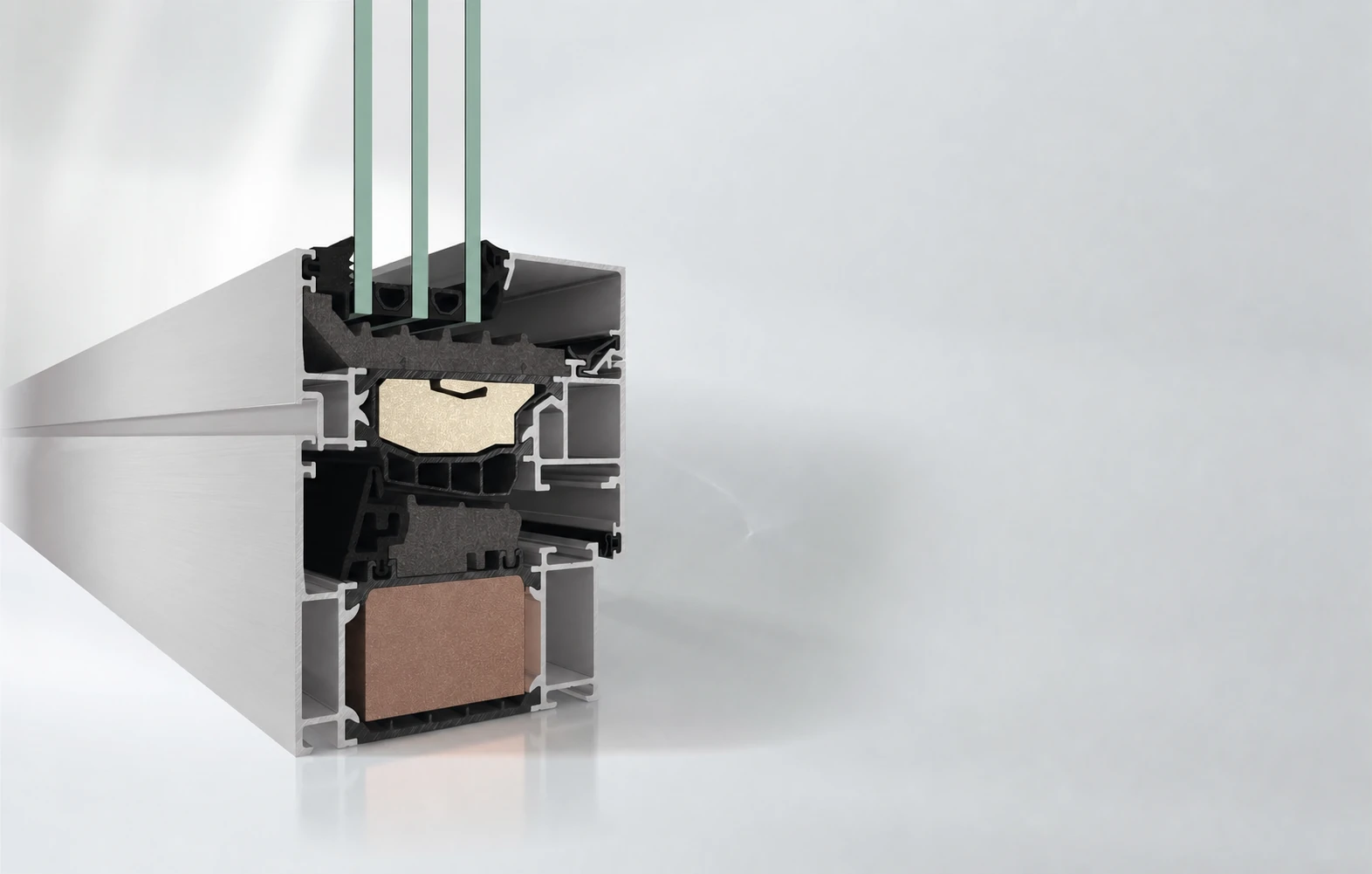
What is a thermal break in an aluminum window?
A thermally broken aluminum frame has separate interior and exterior aluminum sections joined by insulating strips, usually made of polyamide. This plastic conducts much less heat than aluminum, so the strips reduce heat transfer through the frame. They work alongside insulated glass and seals; they do not replace careful installation.
If you are planning large windows, look at the complete assembly. The window anatomy guide explains the frame, sash and hardware. The sash is the movable part of the window; hardware operates and locks it.
Frame U-value, glass U-value and whole-window U-factor
A U-value describes heat transfer through a component. Under comparable conditions, a lower number means better insulation. European system data commonly separates Uf for the frame, Ug for the glass and Uw for the complete window.
Uw accounts for the frame and glass areas and heat transfer around the glass edge. Window size, profile selection and glazing therefore affect the result. A warm-edge spacer is an insulating spacer between the panes at the edge of an insulated glass unit; it helps reduce heat transfer at that edge.
For U.S. projects, check the rating method and units as well as the number. European U-values in W/(m²·K) and U.S. U-factors in Btu/(h·ft²·°F) use different units. Converting units alone does not establish an NFRC-certified rating. Ask for the documentation applicable to the actual product and project.
Why a low U-factor does not tell you everything
U-factor describes insulation. SHGC, the solar heat gain coefficient, describes how much solar heat enters through a window. The right combination depends on climate, orientation and shading. A room with large west-facing windows may need solar control as well as insulation.
Compare double- and triple-pane insulated glass against those needs. Adding a pane is not a substitute for selecting the right glass coating, frame and overall window specification.
Installation and condensation need a separate check
The window-to-wall connection affects performance in the building. Insulation, air sealing and water management at this connection need their own design. An installation thermal bridge is a location where extra heat escapes around the window rather than through the rated window assembly.
A thermal break can help keep the interior frame surface warmer. Condensation still depends on indoor humidity, outdoor temperature, ventilation and installation details. A thermally broken frame cannot guarantee that condensation will never occur.
How to compare Schüco and Reynaers window systems
Start with opening size, operating style, project location and performance requirements. Then compare suitable Schüco aluminum window systems and Reynaers aluminum window systems. Frame depth is the front-to-back dimension of a profile; sightline is the width you see when looking at the window. A slim sightline and a low U-factor describe different aspects of the design.
For a useful project review, provide width and height, the preferred opening type, drawings if available, and the project location. These details help establish a workable frame, glass and hardware combination.
Technical background
The U.S. Department of Energy explains window energy performance. The NFRC explains independent residential product certification, and the Passive House Institute explains installation thermal bridges. These references describe evaluation methods; they do not certify every product on this website.
Choose a system built for your opening.
We can review sizes, performance priorities and system options with your project team.